Esther Tallah, director of the Cameroon Coalition Against Malaria will speak on "Improving Global Public Health By Making US Aid More Effective" at 4 p.m. tomorrow (24 May) in the Interchurch Center, 1100 West 42nd Street, Indianapolis. Dr. Tallah is a pediatrician who directs the Cameroon Coalition Against Malaria (CCAM). Based in Yaoundé, CCAM is recognized as one of the most effective organizations in Africa linking local civil society groups and international efforts to combat that continent’s public health crises.
This Oxfam America event is sponsored by the International Interfaith Initiative, the Center for Interfaith Cooperation and Provocate. For more information, contact Tim Filler, 317:652-6483.
.
Showing posts with label Cameroon. Show all posts
Showing posts with label Cameroon. Show all posts
Sunday, May 23, 2010


Wednesday, October 28, 2009
DePauw Student Connects with Cameroon
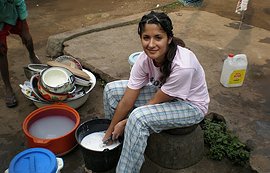 The "welcome" page for The Ashia Project (TAP) is very matter of fact:
The Ashia Project (TAP) is a 501c(3) not-for-profit chapter of Ambassadors for Children committed to supporting those who are determined to change their own community for the better. Currently, we are raising money to help support Dr. Ebanja of Tiko, Cameroon finance the construction of a community hospital.
But the story is ever so much more complicated than that. Read about DePauw University student Tia Malcom (pictured) and her journey to Cameroon and back here: The Ashia Project.
The group's first major fundraising event is being planned for spring 2010 in Indianapolis. Watch for it!
.
Friday, September 25, 2009
Institute for Global Enterprise Programs
 Two major speakers are scheduled for November by the Institute for Global Enterprise at the University of Evansville. First up is Thomas Friedman, columnist for The New York Times and author of several books, including The World is Flat and Hot, Flat, and Crowded. He will speak at a noon luncheon 6 November in the Conrad Hotel in downtown Indianapolis and also give a free 7 p.m. lecture that evening in the Centre Auditorium in Evansville.
 Dr. Christy Djockoua Manyaka Toko will speak on "International Education and the Bridging of Cultures: The Cameroon Experience" at 7 p.m. 16 November in room 170, Schroeder Family School of Business Administration, University of Evansville, 1800 Lincoln Avenue, Evansville. Her presentation, which is free and open to the public, is the keynote address for International Education Week, which is sponsored in part by a grant from the Office of Diversity Initiatives.
Also, Robert Clark, dean of UE’s Schroeder Family School of Business Administration and director of the Institute, will discuss its programs with Indianapolis’s Rotary Club next Tuesday (29 September). UE president, Stephen Jennings, also will attend the meeting at noon in the Scottish Rite Cathedral in Indianapolis.
The Institute for Global Enterprise in Indiana is in its sixth year of activity. As an extension of the Schroeder Family School of Business Administration at UE, its strategic focus is the global marketplace with the objective of enhancing the international business knowledge and skills for UE students and faculty, and increasing global competitiveness for Tri-State businesses.
For more information on these events, email or call 812:488-2455.
.
Thursday, June 7, 2007
Better crop storage method for Africa
A Purdue University team will help residents of 10 African countries increase their supply of cowpeas thanks to an $11.4 million Gates Foundation grant to Purdue Agriculture.
The five-year project on crop storage will cover the countries of Benin, Burkina Faso, Cameroon, Chad, Ghana, Mali, Niger, Nigeria, Senegal and Togo.
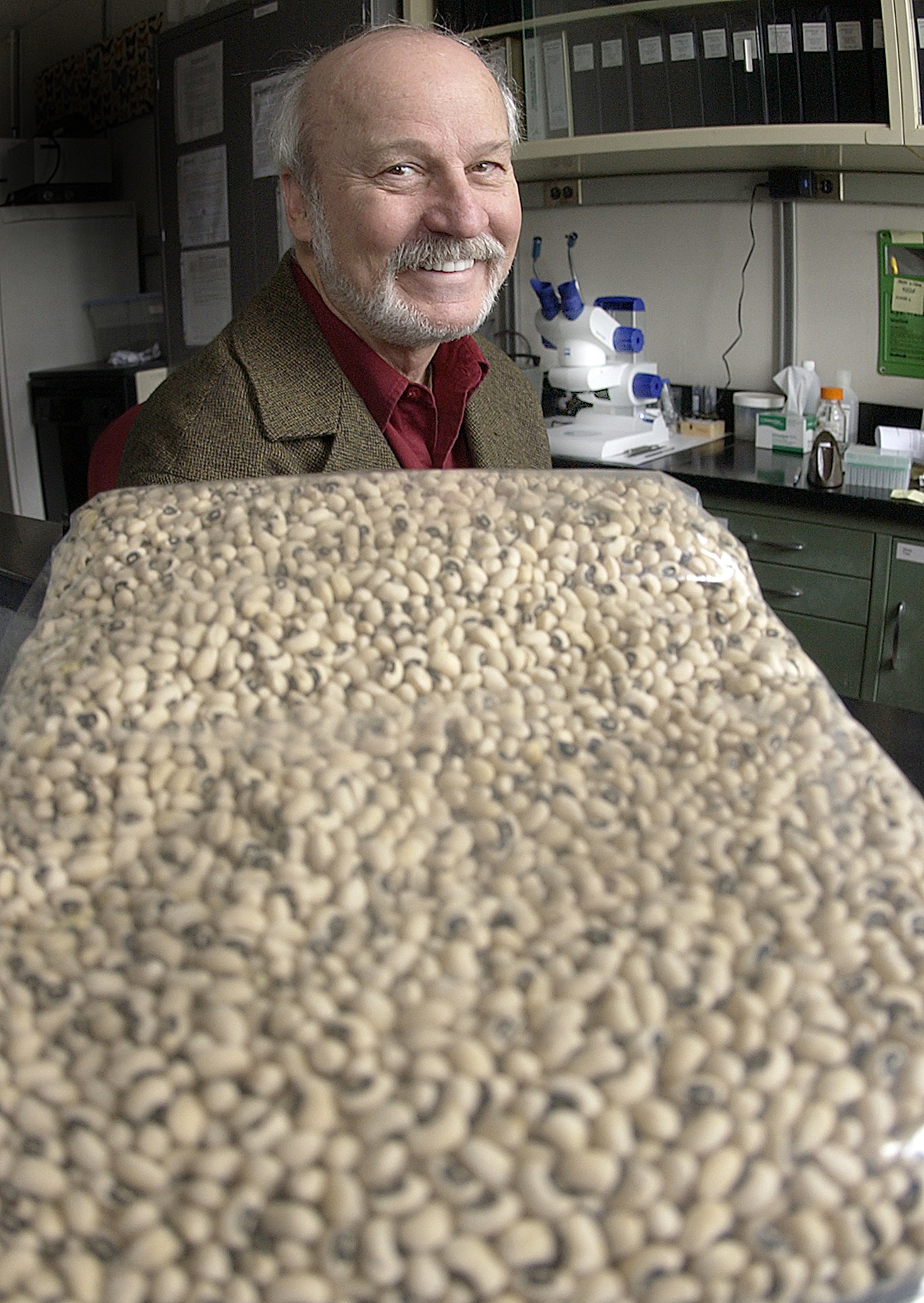
Purdue University entomologist Larry Murdock (at left - with bagged cowpeas!) discovered that cowpea weevils can be controlled if the crop is properly stored. With a one-time cost estimated at a little more than $3 per household, farmers in West and Central Africa will learn how to better protect cowpeas, an important food and cash crop.
Cowpeas, better known in America as black-eyed peas, are marketed by an estimated 3.4 million households in those countries. Even though cowpea yields are low, the legume is one of the few grain crops that can be profitably exported by farmers in this dry, resource-poor part of Africa.
Proven effective in pilot projects, the Purdue-developed hermetic storage method involves triple bagging the cowpeas in plastic and sealing them tight. Not only is the process low-cost - basically the cost of the plastic bags - it's also safer than current practices of either no protection or treating cowpeas with insecticides.
Purdue will work with partners in Africa to recruit and train technicians who will travel from village to village to demonstrate this method for cowpea storage. In addition, the Purdue team will work with manufacturers and suppliers in the region to ensure that appropriate plastic bags are available.
The cowpea is a key crop prioritized in the Alliance for a Green Revolution in Africa's (AGRA) Program for Africa's Seed Systems (PASS), an effort to improve the availability and variety of seeds that can produce higher yields in the often harsh conditions of sub-Saharan Africa.
AGRA is an African-led response to broad calls in Africa for a partnership working across the continent to help millions of small-scale farmers and their families lift themselves out of poverty and hunger. Alliance partnerships focus on key aspects of African agriculture: from seeds, soil health and water to markets, agricultural education and policy.
AGRA is based in Nairobi and supported by the Gates Foundation and the Rockefeller Foundation.
Subscribe to:
Posts (Atom)

