
Showing posts with label Senegal. Show all posts
Showing posts with label Senegal. Show all posts
Friday, June 26, 2009


Thursday, May 7, 2009
International Business Owners to Visit Bloomington
The Bloomington Life Sciences Partnership, a program of the Bloomington Economic Development Corporation, will host seven international business owners, reports Inside INdiana Business (although no dates for the visit have been announced).
The group will learn about the city's growing presence as a life sciences hub, participate in a brief tour and visit local life sciences organizations. Representatives include a provincial governor, business owners and agency directors from Angola, Egypt, Philippines, Rwanda, Senegal and Serbia.
.
The group will learn about the city's growing presence as a life sciences hub, participate in a brief tour and visit local life sciences organizations. Representatives include a provincial governor, business owners and agency directors from Angola, Egypt, Philippines, Rwanda, Senegal and Serbia.
.
Tuesday, January 27, 2009
Indy Students Reach out to Senegal
A group of fourth-grade students at Greenbriar Elementary in Indianapolis' Washington Township have collected clothes for children in Senegal, reports Gretchen Becker of The Indianapolis Star.
Students in Fatima Rich's class, calling themselves the Green Givers Group, collected clothing and cash to purchase more clothing. Their donation will be distributed in Dakar through the Wings for West Africa program based at North Central High School in Indianapolis.
Students in Fatima Rich's class, calling themselves the Green Givers Group, collected clothing and cash to purchase more clothing. Their donation will be distributed in Dakar through the Wings for West Africa program based at North Central High School in Indianapolis.
Wednesday, October 8, 2008
Museums in Africa and the United States
 Dr. Boureima Diamitani, executive director of the West African Museum Programme, will join Dr. Maxwell L. Anderson for a conversation about colonial collections and post-colonial communities, conserving cultural and art history, and the impact of civil wars on cultural heritage preservation.
The event begins at 6:30 p.m. tomorrow (9 October) in the Deer Zink Events Pavilion of the Indianapolis Museum of Art, 4000 Michigan Road, Indianapolis. It's open to the public at no charge as part of the Conversation Series: Museums in a Global Context (in honor of the 125th anniversary of the IMA).
Monday, July 9, 2007
South Africa and Senegal Featured at Black Expo
Summer trips to South Africa and the West African nation of Senegal by Expo staff will be reflected in art exhibits and economic forums at the 37th annual Indianapolis Black Expo, according to The Indianapolis Star.
The cultural event kicks off Thursday and ends 22 July.
See website for a schedule of events.
The cultural event kicks off Thursday and ends 22 July.
See website for a schedule of events.
Thursday, June 7, 2007
Better crop storage method for Africa
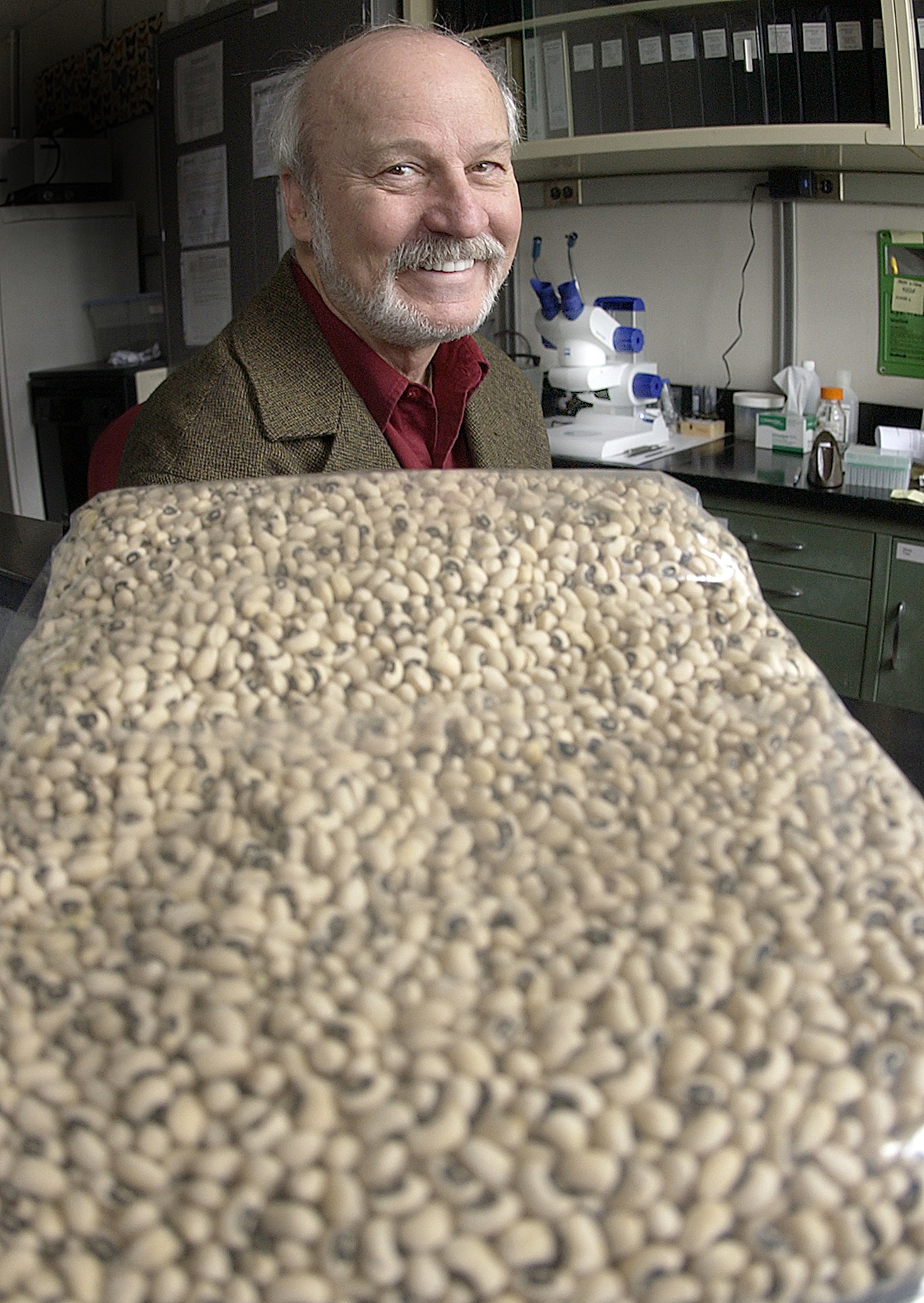
A Purdue University team will help residents of 10 African countries increase their supply of cowpeas thanks to an $11.4 million Gates Foundation grant to Purdue Agriculture.
The five-year project on crop storage will cover the countries of Benin, Burkina Faso, Cameroon, Chad, Ghana, Mali, Niger, Nigeria, Senegal and Togo.
Purdue University entomologist Larry Murdock (at left - with bagged cowpeas!) discovered that cowpea weevils can be controlled if the crop is properly stored. With a one-time cost estimated at a little more than $3 per household, farmers in West and Central Africa will learn how to better protect cowpeas, an important food and cash crop.
Cowpeas, better known in America as black-eyed peas, are marketed by an estimated 3.4 million households in those countries. Even though cowpea yields are low, the legume is one of the few grain crops that can be profitably exported by farmers in this dry, resource-poor part of Africa.
Proven effective in pilot projects, the Purdue-developed hermetic storage method involves triple bagging the cowpeas in plastic and sealing them tight. Not only is the process low-cost - basically the cost of the plastic bags - it's also safer than current practices of either no protection or treating cowpeas with insecticides.
Purdue will work with partners in Africa to recruit and train technicians who will travel from village to village to demonstrate this method for cowpea storage. In addition, the Purdue team will work with manufacturers and suppliers in the region to ensure that appropriate plastic bags are available.
The cowpea is a key crop prioritized in the Alliance for a Green Revolution in Africa's (AGRA) Program for Africa's Seed Systems (PASS), an effort to improve the availability and variety of seeds that can produce higher yields in the often harsh conditions of sub-Saharan Africa.
AGRA is an African-led response to broad calls in Africa for a partnership working across the continent to help millions of small-scale farmers and their families lift themselves out of poverty and hunger. Alliance partnerships focus on key aspects of African agriculture: from seeds, soil health and water to markets, agricultural education and policy.
AGRA is based in Nairobi and supported by the Gates Foundation and the Rockefeller Foundation.
Subscribe to:
Posts (Atom)

